Why Most Enterprise Renewals Are Lost Months Before Renewal
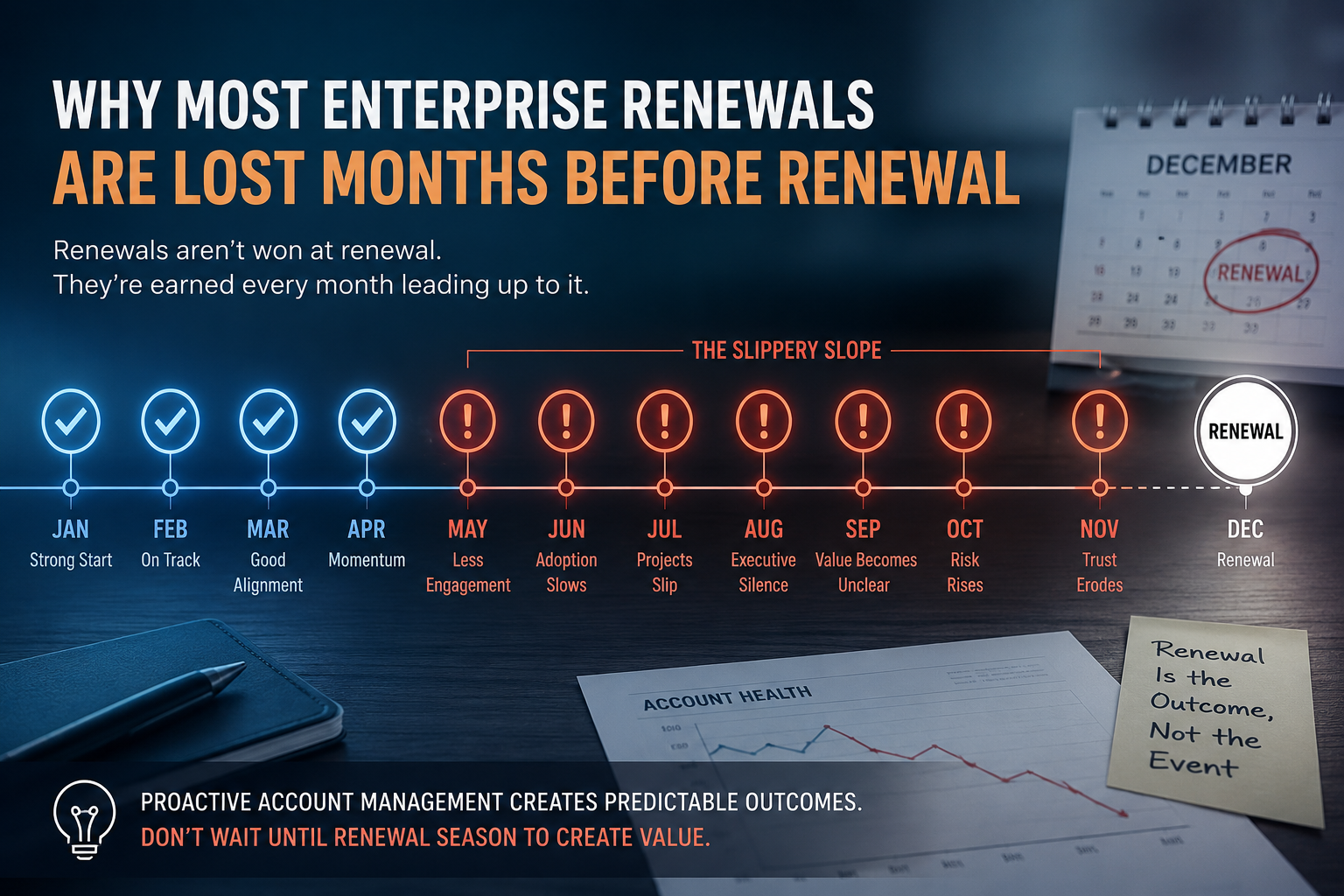
One of the biggest mistakes companies make in customer success is treating renewals like an event instead of an outcome.
By the time a renewal becomes urgent, the customer has usually already decided how they feel about the partnership.
That decision gets shaped over months — sometimes years — through:
responsiveness,
strategic alignment,
adoption progress,
executive communication,
and whether the customer consistently sees value.
The best account management teams understand this.
They don’t manage accounts reactively.
They operate with cadence.
During my time leading enterprise customer relationships at Verint, we built a structured customer engagement model designed to keep accounts aligned, healthy, and progressing throughout the year.
It included:
formal onboarding,
recurring health reviews,
quarterly business reviews,
adoption checkpoints,
support/project reviews,
and early renewal planning.
At first glance, it may sound operational.
But in reality, it was strategic.
Because enterprise customer success is rarely about solving one big problem.
It’s about preventing dozens of small disconnects from accumulating over time.
When cadence breaks down:
executive sponsors disengage,
adoption slows,
projects drift,
support frustrations compound,
and value becomes harder to articulate.
Eventually, renewal conversations become difficult because alignment disappeared months earlier.
Strong customer leadership avoids this by creating consistent rhythms around:
communication,
accountability,
success metrics,
and future planning.
One of the most valuable lessons I learned is this:
Customers rarely leave because of a single incident.
They leave because the relationship gradually became less strategic.
That’s why great account management requires more than relationship-building skills.
It requires:
operational discipline,
business acumen,
executive presence,
organizational awareness,
and the ability to continuously reconnect solutions to business outcomes.
The strongest customer-facing organizations are the ones that make value realization visible and ongoing.
Not quarterly.
Not at renewal.
Continuously.
And in today’s enterprise environment, where retention and expansion matter more than ever, that discipline becomes a competitive advantage.